Category: crafts

Introduction

Hello.  I’m Penny.

Photo on 05-08-2018 at 11.26I’m halfway through a ceramics design course and my homework is to write a blog.

I’ve always been interested in crafts and learnt to knit and sew as a child

cropped-mice-in-cks-bowl.jpg
Catnip mice (4/12/2015), porcelain bowl by Chris Keenan
IMG_0707
Pteranodon (April 2017)

In 2010 I took up ceramics at my local adult education college, making mostly wheel-thrown functional domestic ware.

Some of my pots
Some of my pots 29/06/2017

In 2017 I started an HNC diploma in 3-D design (ceramics), which seems a bit of a mouthful so I call it How to Make Better Cat Dishes.  My aim is to learn new making and decorating techniques and to think about the design beforehand so that I make better, more considered pots rather than just sitting at the wheel and throwing whatever the lump of clay wants.  The course emphasises ideas generation and research.  I have to keep a sketch book and technical journal (rather than just the notebook I used to use) as a record of the development of my work from initial idea to finished piece.  It is a good (if onerous) discipline.  I often use Pinterest boards to collect together visual ideas for a particular project.  The boards act as reminders of makers and techniques for further research and I put the results in my sketch book.  I have always enjoyed going to exhibitions.  I now look at the work more critically and analytically, taking notes (and photos, where possible).  These, too, go in my sketch book.  Artists’ open studios are another excellent resource.  It’s an invaluable opportunity to talk to contemporary makers who always seem happy to share their ideas and expertise and I get to fondle their pots.  A  favourite is Vanguard Court in Peckham, home to  Chris Keenan, Carina Ciscato and Sun Kim, three potters who offer very different takes on wheel-thrown porcelain.

The assignments each term have been in two parts, a theme for making and ceramic techniques to learn.  The first theme was Small batch production: pouring vessels with different construction methods.

Soft slab jugs


An exercise in soft earthenware slabs – making copies of other potters’ work. Hideous.

Hard slab jug


My own design in hard earthenware slabs.  Also hideous.


However, I did go on to make an earthenware piggy bank, part thrown and part slabbed, so I must have learnt something.

Blue piggy bank


The body and trotters are joined when leather hard – a hard slab technique.

The ears and curly tail are soft slabs.


Here are some pourers I threw – they would not be out of place on my kitchen dresser.

3 pourers

I was introduced to porcelain casting slip, a very different medium.  I tried a burn out technique where the slip is added to material which will burn away in the kiln.

20180811_151557

I sewed a pourer out of cotton muslin (it has to be natural fibre), dipped it in slip and hung it up to dry.  There is an intriguing dissonance between the soft drape of the fabric and the brittle rigidity of the porcelain.

20180812_120059


It is possible to see the weave of the fabric and details of the sewing inside.


I tried knitted shapes with similar results.

20171215_121954

20180811_164942


They are unexpectedly light as the ceramic is much lower density than pure clay.  On a practical note, burn out pieces can be porous, which isn’t ideal for a pouring vessel.  The knitted pieces weep gently if I fill them with water.

I have tried to use the new techniques in different assignments.  This gives me the chance to develop them and reinforces my learning.  The theme for the final term was Enclosure and I continued with burn out forms and porcelain slip.  I made a rattle (below) by enclosing pre-fired ceramic beads in an inflated balloon, being careful not to burst the balloon (again), and then draping strips of slip-soaked muslin across it.  I based the shape on a Sri Lankan brass rattle which I found in the British Museum online catalogue.

20180705_194414

I knitted a pig, also dipped in slip, and used a balloon and strands of yarn to support the shape as it dried (see Burnout post).

Knitted piggy bank

I didn’t add enough slip where the legs joined the body and cracks appeared during bisque firing.  I repaired them with paper clay and rebisqued but it still wasn’t enough and the right foreleg collapsed during the glaze firing.  Fortunately, the pig balances well on its tail in an amiable, waving pose.  It has a slot in its back and enclosed ceramic coins.

I had hoped to see more of the stitch texture with the knitted forms.  It doesn’t show at all in the pourers (unlike the muslin).  It is vaguely visible on the edges of the pig’s ears and snout and can just be seen inside in the right light.  After making them, I discovered the work of Helen Gilmour, Caroline Andrin and Annette Bugansky, who use knitted vehicles for their slipwork, with beautifully clear results.  I shall write about them in my next blog.

~~~

Post Script: Before and After

I made cat water dishes at the beginning and end of the year.  The first was based on the idea of Beneath.  I used newspaper resist (a sort of negative stencil) and coloured slips to hide a design beneath the different layers of slip.  I didn’t apply the slips carefully enough and they blistered on firing, which spoilt the design, and I don’t like the final colours very much.  The second was part of the Enclosure project.  I painted on coloured slips (more carefully this time) then used frog tape at the glaze stage to mask an enclosed pond design.  I had problems getting enough glaze onto the pot, especially on the outside, so again the design isn’t quite as intended but the colours are better.  I know which one the cat prefers.

Knitting and Ceramics: Helen Gilmour, Caroline Andrin and Annette Bugansky

I learnt to knit some 50 years ago and this has given me a repertoire of pattern and texture which I would like to draw on in my ceramics (Nigel says I’m “recontextualising knitting”1).  Pots are made to be handled, at least mine are, and surface texture is an important part of the tactile as well as visual experience.  It can be functional, giving extra grip to a pouring vessel, and knitted textures bring an added clash of expectations between the soft warmth of woollens and hard ceramic.

I made four pieces involving knitting over the past year.  Here are two knitted pourers, dipped in porcelain slip with the yarn burnt out during firing.  The slip is quite thick, which is good for the structural integrity of the pieces (although they aren’t watertight), but it completely obscures the stitches.

20171215_12195420180811_164942

I knitted a pig, also dipped in porcelain slip and supported by a balloon and strands of yarn whilst drying.

Knitted piggy bank

The slip is thinner and the stitches are occasionally visible (on the ears and snout and inside) but I had problems with cracking and slumping in the kiln.

My most successful replica of knitting is this tile.

IMG_0838

DNA cable

I knitted a cable panel of a DNA double helix2 and pressed the design into soft clay with a rolling pin.  There is beautiful clarity to the stitch detail, even down to the layering of the cable twists.  It definitely looks stitchy.


Since making these pieces I have discovered the work of Helen Gilmour, Caroline Andrin and Annette Bugansky, who all use knitting in various ways to add structure or texture to their work.  Gilmour is a Scottish ceramicist, interested in traditional crafts.  She takes domestic functional ceramic forms, such as the teapot, and creates porcelain sculptures via the medium of knitting.  They are individual and idiosyncratic with just the sort of personal detail of handle or knob one would find in a handbuilt piece.  But knitted.  My kinda gal.

https://ceramicartsnetwork.org/wp-content/uploads/s3/2013/05/24141016/knittedteapot_6201.jpg
Helen Gilmour (2011), Teapot (photo by the artist)

She uses the same burn out technique as for my pig but has developed and refined it to reveal the knitted structure.  She uses cotton yarn to knit the component pieces, saturates them with porcelain slip, wrings them out and stretches them over formers.  She adds more slip to strengthen the pieces whilst leaving the stitches clearly visible.  She fires once at 1280ºC, which burns out the yarn and vitrifies the porcelain, then assembles the pieces afterwards.  (Actually, the teapot base is made from porcelain paper clay, rolled out on a knit-textured plaster bat, a bit like my DNA tile, and attached before firing.)  This technique gives a unique, positive reproduction of the original knitting.  A full description is included in Additions to Clay Bodies (Standen, 2013, pp. 70-72) and published online by Ceramic Arts Network.

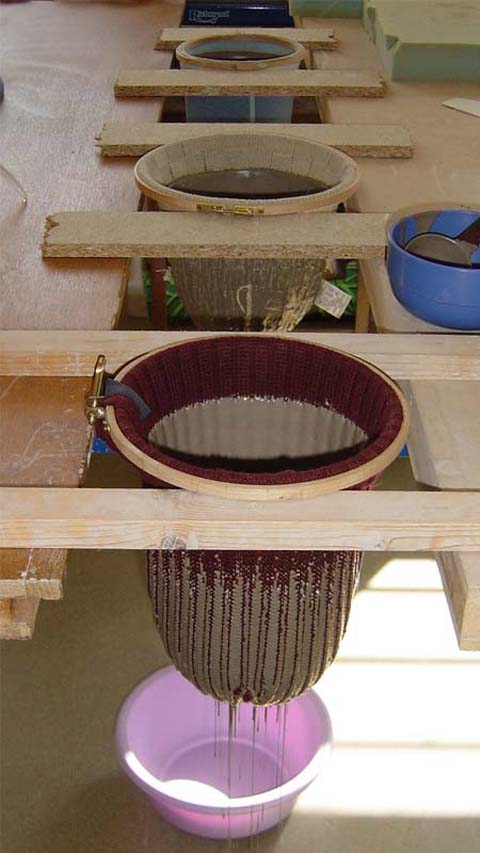
The Swiss ceramicist Caroline Andrin uses knitting in her slip-casting.  She is curious about the intimacy of skin contact and the idea of a form within a form and often chooses clothes as moulds.  She wants to reveal the inner surface on the outside of the final piece (that’s moulds for you)3.  I knit my own pieces (more self-expression, though not in an attention-seeking Tracey Emin way, I hope) but she uses found objects, such as gloves or hats.  She secures the garment with a tapestry frame and pours in slip.  After adjusting the thickness at the rim, she removes the excess and leaves it to dry.

caroline andrin céramiste belgique belge artiste designer suisse artiste artistes potier poterie céramique céramiques
Cap bowls in preparation (photo: Ivan Citelli)

Finally she peals back or cuts away the mould to reveal the clay surface.

caroline andrin céramiste belgique belge artiste designer suisse artiste artistes potier poterie céramique céramiques
Sky blue cap bowl being unmoulded (photo: Ivan Citelli)

The bowls have a natural domed shape from the way they are cast and clearly show the internal knitted texture.  Is that what my head feels when I wear a hat?  These 3 have been strikingly displayed with their matching moulds.

caroline andrin céramiste belgique belge artiste designer suisse artiste artistes potier poterie céramique céramiques
Caroline Andrin, 3 Cap-bowls (photo: Ivan Citelli)


Her work is directed by the found moulds, which she may reshape by stitching, and these are by no means all knitted.  She made a remarkable series of bathing cap bowls.

caroline andrin céramiste belgique belge artiste designer suisse artiste artistes potier poterie céramique céramiques
Caroline Andrin, Porcelain Flowered Cap 1 (photo: Ivan Citelli)
caroline andrin céramiste belgique belge artiste designer suisse artiste artistes potier poterie céramique céramiques
Caroline Andrin (2010), Send it by mail


These are vases made from cardboard packing tubes.


Her moulds all give a negative print of the original texture.

British designer Annette Bugansky worked in textiles and tailoring (like her father, a tailor in Savile Row) before turning to ceramics and is an accomplished knitter and seamstress.  She makes an original form and knits (or crochets or embroiders) an overcoat for it.  She then takes a plaster mould, enabling her to make repeat slip-castings of the positive form of the knitting and yielding functional, watertight pieces.  The inside surfaces follow the knitted contours, like a real garment, with the creamy, unglazed exterior mimicking an Aran sweater.  It’s just gagging to be touched.

Image result for annette bugansky
Annette Bugansky, Cable Jug

Note the lovely lip shape and intricate cable detail (with its useful grip).  Knitting can incorporate complex 3-D shaping as well as pattern and texture.


~~~

Post Script

I noticed when researching these pieces that combining knitting and ceramics is a field dominated by women.  Formerly in Britain knitting was an economic activity practised by men, but the mechanisation of the Industrial Revolution led to handknitting being relegated to the domestic sphere of women.  Handknitting further declined with mass production of woollen garments and by the later 20th century it was a hobby activity (traditional crafts remained more popular in continental Europe).  Knitting is currently seeing a resurgence, both with women and men and there are now male knitwear designers such as Kaffe Fassett.  This can be viewed as part of a continuing re-evaluation of women’s roles in society and gender equality and knitting is no longer being disregarded as merely for girls.  Knitting is also used in the political context of yarn bombing and craftivism.  On a personal level, I’m not trying to make a political point or promote particular crafts (unlike the Arts and Crafts movement), I just want to exploit my skill set, acquired in the more sexist times of the 1960s.  I do, however, think that knitting is an appropriate vehicle for art.

yarn_bomb_01
Marianne Jørgensen (2006), Tank Blanket (photo by the artist)


Footnotes

1. Nigel Hackney: In conversation, The Crown, 17/08/2018. Talking of recontextualisation (a route for cultural transmission), Jeremy Deller does it a lot (in collaboration), whether applying macho motorbike art to mundane tea paraphernalia (Souped Up Tea Urn & Teapot, 2004) or arranging Acid House music for brass band (Acid Brass, 1997).  It gives a fresh perspective to all the art forms involved.  It is common in music where the composer writes a template for performance, which is then open to interpretation and reinterpretation.  Before the advent of recording Franz Liszt transcribed many works for piano, including Beethoven symphonies, which enabled them to be performed and heard in a domestic setting.  Maurice Ravel reversed the process with orchestrations of piano pieces (both his own and others’).
2. Double helix cable pattern by June Oshiro, January 2002, ravelry.com
3. Rachael Whiteread explored found moulds on a much grander scale in her Turner Prize-winning House (1993), where she replicated the inside of a condemned house by spraying liquid concrete into the building’s empty shell before its external walls were removed.

Looking at Design

I’m studying for a diploma in 3-D design (ceramics) and, although it’s a ceramics course, there is a strong emphasis on the design process, from the initial brief through to the final piece.  I thought I would analyse this process by looking at something I have been designing and making for a long time – knitted tea cosies.

s&w tea cosy

I like a nice cup of tea, made with loose leaves in a pot, and there’s nothing that helps the tea along better than a good tea cosy (and a homemade teapot, obviously).

When designing, I’m supposed to think about form, function and the end-user.  I make tea cosies mostly for me and it is an opportunity for unbridled self-indulgence (see above).  Form – it needs to fit the teapot, with holes for the handle and spout (unless it’s one of those ones that go over the whole pot, in which case make it out of fabric with a thermal lining instead), with enough stretch to put the cosy on, which is where the knitting comes in handy.  Function – it needs to keep the pot warm, so not a flimsy lacy thing.  There might also be a secondary function of adding decoration (a human practice since prehistoric times) to a plain teapot.

There are three main variables to fix when designing a tea cosy – yarn, stitch pattern and style.  I usually start with the teapot and look at the colours on it, then choose some appropriate wool from my leftovers – it’s very rare for me to actually need to buy yarn for a tea cosy.  Reds and browns are good as they don’t show the tea stains much.  Tweedy flecked yarns go well with earthy pots and plain yarns look smart on porcelain.  Wool or silk/wool mixes keep the heat in best.  I then decide on a stitch pattern.  Knitting is supremely versatile for decoration (both pattern and texture) but certain stitches only work with the right yarn – Fair Isle, say, needs a fine yarn for the shapes not to look pixellated.  I have stitch directories and pattern books to consult and there’s always the internet.  I favour the traditional fitted style of cosy, knitting in the round (with a plain lining if the yarn is fine) and decreasing at the top to close the shape.


I make maquettes in the form of tension squares to work out how many stitches are needed and to try different colour combinations.  There can be an element of trial and error as it’s easy to unpick and reknit a small thing like a tea cosy.

My first tea cosy was a copy of one made by my late grandmother.  It had a clever bumpy pattern with insulating air pockets.  I couldn’t ask her how she’d done it and had to reconstruct the stitch from the decaying original.  Years later I found it in one of my stitch books with a much simpler way of achieving it.  It’s now become my default pattern.  I can use a range of colours for the bubbles or even just the same as the background for a textured monochrome (a bit too Kelly Hoppen for me).  This grey and blue tea cosy was originally knitted for a (sadly defunct) blue teapot with a black spotty design.  It’s now sported by a teapot I made with a flecked clay and my own teal glaze.


My elephant teapot needed a different cosy shape.  I chose red and green wool to go with the floral decoration and a zigzag stitch that intrigued me.  It has increases and decreases within the rows to create zigzag stripes with a scalloped edge.


The ridge at the top is like the toe of a sock.  After knitting in the round, I pushed the two halves together and cast off two stitches at a time.

Elephant tea cosy


Sometimes I have a technique that I want to try and a tea cosy is a handy test piece.  Here is one where I tried steeking (from my Fair Isle designs book), a Shetland pullover technique where the knitting is cut, like fabric.  I found the stitch pattern on the internet and had some 4-ply Shetland yarn.  I’ve yet to be brave enough to cut the holes for the spout and handle.

steeked-tea-cosy-1.jpg


Sometimes I’ll adapt a commercial pattern.

Pink twist tea cosy 2
Vicky Walker, Pink Twist

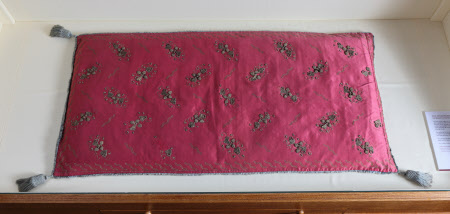
I found this in one of my tea cosy books and it reminded me of a delightful 16th century cushion that I once saw at Hardwick Hall in Derbyshire.  It was beautifully embroidered with a strawberries and worms motif.  With a little Swiss darning, I was able to make the cosy at the top of this post.


Hardwick Hall © National Trust / Robert Thrift
Cushion, Hardwick Hall, Derbyshire (©National Trust/Robert Thrift)


S&W tea cosy lining

I also gave it a strawberry fabric lining.  Fabric linings are tricky as they don’t stretch like the knitting but still need to fit over the pot.


Here are some from my current collection, with my earliest tea cosy in the middle, adorning a John Leach teapot.

My tea cosies


Occasionally the end user isn’t me – here’s one I knitted for my mum.

Mum's tea cosy

She loves orange so I chose (practical) autumnal shades.  It’s a combination of commercial patterns.  I knitted two body squares on the bias, then sewed them together, leaving gaps for the handle and spout, and added knitted flowers and leaves.


I knitted one for my niece, Harriet, who had just finished a science journalism course.  For her final project she co-created Genetiknits, a history of genetics in knitting, so I felt it should be a DNA-inspired work.  I found a double helix cable pattern online and adapted it to the tea cosy.  The two RNA helical strands are a conventional Aran cable style but I did them in two colours for contrast.  The base pair links are embroidered on afterwards (using scientific convention for the colours).  The vertical panel divides are a cable twist, continuing the helical theme.  I added an embroidered version of Rosalind Franklin’s X-ray photo 51 on the top, although it doesn’t show up too well in my photo.  My niece was gratifyingly pleased with it and gave it a whole Genetiknits tea cosy post of its own.

IMG_2404 DNA teapot copy

That gives me an idea for a teapot.

~~~

So, how does this apply to ceramics?

If I’m not the end user (although I may be), it’s still an opportunity for self-expression, otherwise why choose me as the maker, but I might have to consider other aesthetics.  There are just as many reference books and internet sources for ceramics as knitting – directories of shape and form, books of objects (1000 tiles, 500 teapots), Ceramic Arts Network online, as well as museums and galleries and everyday objects.  It is easy to crib be inspired by and adapt other people’s work.

Cost is a much more important factor with ceramics.  I make tea cosies out of leftover yarn and can unpick my mistakes but pots require raw ingredients, kiln firings, studio space and time, not to mention skill.  This means maquettes and tests are crucial, as most steps in ceramics are not reversible.

Choice of materials: What yarn/clay?  What colours/glaze?  What pattern/decoration?  Does it enhance the function and/or form?

Does the design fit the brief?  There’s no point constructing a monotony in beige (Kelly Hoppen) if my mum says it has to be orange.

Most importantly, why clay?  Why not use a different medium?  I mean, who’d knit a teapot?

https://ceramicartsnetwork.org/wp-content/uploads/s3/2013/05/24141016/knittedteapot_6201.jpg
Helen Gilmour (2011), Teapot (photo by the artist)

(There’s more about Helen Gilmore in my post Knitting and Ceramics.)