
I learnt to knit some 50 years ago and this has given me a repertoire of pattern and texture which I would like to draw on in my ceramics (Nigel says I’m “recontextualising knitting”1). Pots are made to be handled, at least mine are, and surface texture is an important part of the tactile as well as visual experience. It can be functional, giving extra grip to a pouring vessel, and knitted textures bring an added clash of expectations between the soft warmth of woollens and hard ceramic.
I made four pieces involving knitting over the past year. Here are two knitted pourers, dipped in porcelain slip with the yarn burnt out during firing. The slip is quite thick, which is good for the structural integrity of the pieces (although they aren’t watertight), but it completely obscures the stitches.


I knitted a pig, also dipped in porcelain slip and supported by a balloon and strands of yarn whilst drying.

The slip is thinner and the stitches are occasionally visible (on the ears and snout and inside) but I had problems with cracking and slumping in the kiln.
My most successful replica of knitting is this tile.


I knitted a cable panel of a DNA double helix2 and pressed the design into soft clay with a rolling pin. There is beautiful clarity to the stitch detail, even down to the layering of the cable twists. It definitely looks stitchy.
Since making these pieces I have discovered the work of Helen Gilmour, Caroline Andrin and Annette Bugansky, who all use knitting in various ways to add structure or texture to their work. Gilmour is a Scottish ceramicist, interested in traditional crafts. She takes domestic functional ceramic forms, such as the teapot, and creates porcelain sculptures via the medium of knitting. They are individual and idiosyncratic with just the sort of personal detail of handle or knob one would find in a handbuilt piece. But knitted. My kinda gal.

She uses the same burn out technique as for my pig but has developed and refined it to reveal the knitted structure. She uses cotton yarn to knit the component pieces, saturates them with porcelain slip, wrings them out and stretches them over formers. She adds more slip to strengthen the pieces whilst leaving the stitches clearly visible. She fires once at 1280ºC, which burns out the yarn and vitrifies the porcelain, then assembles the pieces afterwards. (Actually, the teapot base is made from porcelain paper clay, rolled out on a knit-textured plaster bat, a bit like my DNA tile, and attached before firing.) This technique gives a unique, positive reproduction of the original knitting. A full description is included in Additions to Clay Bodies (Standen, 2013, pp. 70-72) and published online by Ceramic Arts Network.
The Swiss ceramicist Caroline Andrin uses knitting in her slip-casting. She is curious about the intimacy of skin contact and the idea of a form within a form and often chooses clothes as moulds. She wants to reveal the inner surface on the outside of the final piece (that’s moulds for you)3. I knit my own pieces (more self-expression, though not in an attention-seeking Tracey Emin way, I hope) but she uses found objects, such as gloves or hats. She secures the garment with a tapestry frame and pours in slip. After adjusting the thickness at the rim, she removes the excess and leaves it to dry.
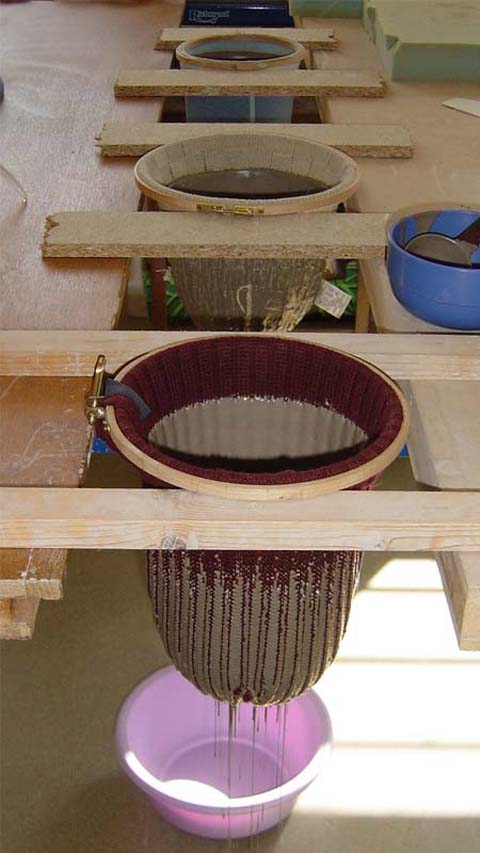
Finally she peals back or cuts away the mould to reveal the clay surface.

The bowls have a natural domed shape from the way they are cast and clearly show the internal knitted texture. Is that what my head feels when I wear a hat? These 3 have been strikingly displayed with their matching moulds.

Her work is directed by the found moulds, which she may reshape by stitching, and these are by no means all knitted. She made a remarkable series of bathing cap bowls.


These are vases made from cardboard packing tubes.
Her moulds all give a negative print of the original texture.
British designer Annette Bugansky worked in textiles and tailoring (like her father, a tailor in Savile Row) before turning to ceramics and is an accomplished knitter and seamstress. She makes an original form and knits (or crochets or embroiders) an overcoat for it. She then takes a plaster mould, enabling her to make repeat slip-castings of the positive form of the knitting and yielding functional, watertight pieces. The inside surfaces follow the knitted contours, like a real garment, with the creamy, unglazed exterior mimicking an Aran sweater. It’s just gagging to be touched.
Note the lovely lip shape and intricate cable detail (with its useful grip). Knitting can incorporate complex 3-D shaping as well as pattern and texture.
~~~
Post Script
I noticed when researching these pieces that combining knitting and ceramics is a field dominated by women. Formerly in Britain knitting was an economic activity practised by men, but the mechanisation of the Industrial Revolution led to handknitting being relegated to the domestic sphere of women. Handknitting further declined with mass production of woollen garments and by the later 20th century it was a hobby activity (traditional crafts remained more popular in continental Europe). Knitting is currently seeing a resurgence, both with women and men and there are now male knitwear designers such as Kaffe Fassett. This can be viewed as part of a continuing re-evaluation of women’s roles in society and gender equality and knitting is no longer being disregarded as merely for girls. Knitting is also used in the political context of yarn bombing and craftivism. On a personal level, I’m not trying to make a political point or promote particular crafts (unlike the Arts and Crafts movement), I just want to exploit my skill set, acquired in the more sexist times of the 1960s. I do, however, think that knitting is an appropriate vehicle for art.

Footnotes
1. Nigel Hackney: In conversation, The Crown, 17/08/2018. Talking of recontextualisation (a route for cultural transmission), Jeremy Deller does it a lot (in collaboration), whether applying macho motorbike art to mundane tea paraphernalia (Souped Up Tea Urn & Teapot, 2004) or arranging Acid House music for brass band (Acid Brass, 1997). It gives a fresh perspective to all the art forms involved. It is common in music where the composer writes a template for performance, which is then open to interpretation and reinterpretation. Before the advent of recording Franz Liszt transcribed many works for piano, including Beethoven symphonies, which enabled them to be performed and heard in a domestic setting. Maurice Ravel reversed the process with orchestrations of piano pieces (both his own and others’).
2. Double helix cable pattern by June Oshiro, January 2002, ravelry.com
3. Rachael Whiteread explored found moulds on a much grander scale in her Turner Prize-winning House (1993), where she replicated the inside of a condemned house by spraying liquid concrete into the building’s empty shell before its external walls were removed.




 Penny's HNC blog